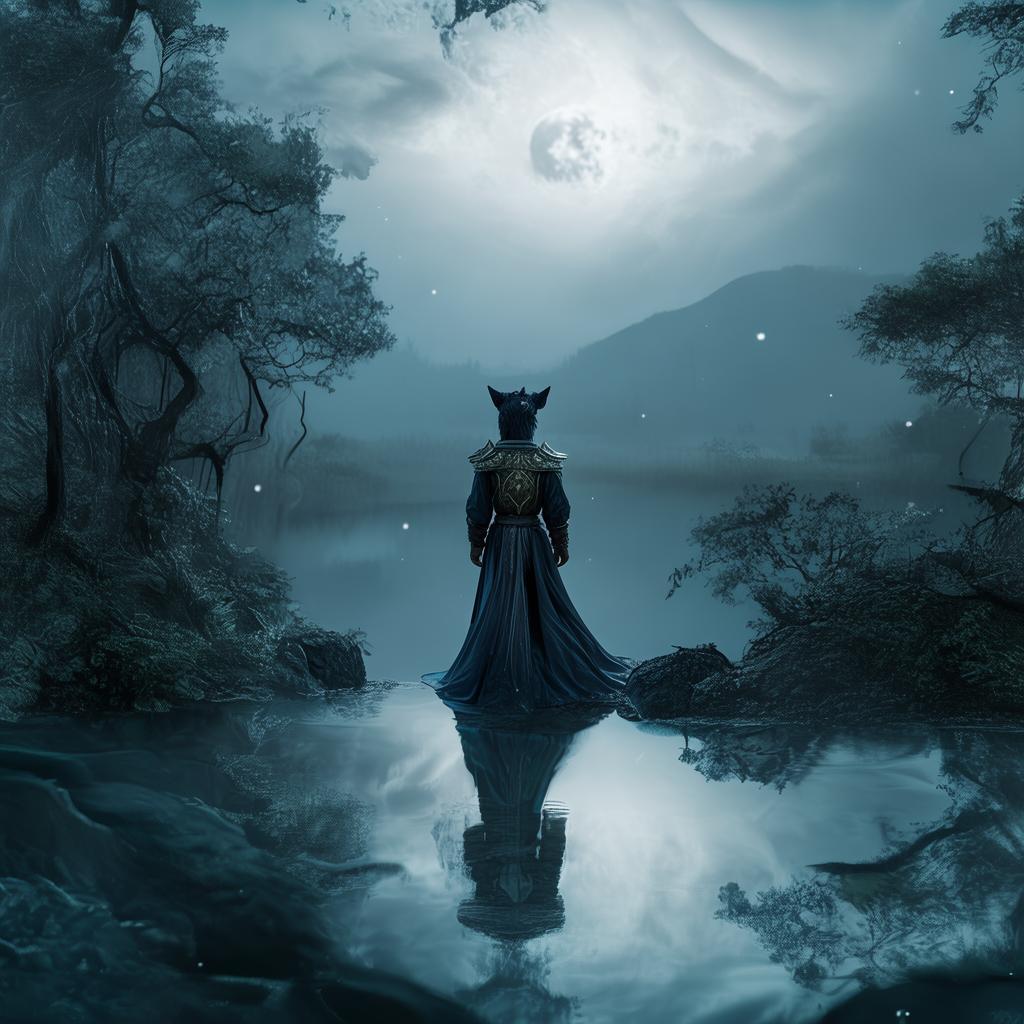
The Wandering Shadows of Wei Zongwan
In the serene village of Jingzhou, there lived a scholar named Wei Zongwan, known for his wisdom and compassion. His scholarly pursuits and virtuous life were the talk of the town, but little did the villagers know of the dark secret that clung to him—a curse that bound him to wander the earth in the form of his own shadow.
The story begins with Wei Zongwan at the height of his career, teaching the young and imparting wisdom. Yet, as the tale unfolds, we discover that he was no ordinary man. He had once been involved in a grave misdeed, an act that he has since repented, but which has not been absolved by the heavens.
One evening, as Wei Zongwan walked through the village, a chilling wind swept through the streets. He turned to see his own shadow detach from his feet and begin to wander on its own. The shadow was a malevolent force, haunting him wherever he went, never allowing him to escape its reach.
The villagers were puzzled by the sight of Wei Zongwan’s shadow wandering without him. Some whispered about the curse, others about a spirit that had taken residence within the shadow. But Wei Zongwan was determined to understand the nature of this curse and find a way to break it.
He embarked on a journey that took him to the ancient tombs and forgotten temples of China. He sought the counsel of wise men and women, and he encountered spirits of the past and present, each with their own tales of sorrow and redemption. Through his travels, Wei Zongwan learned about the interconnectedness of life and the consequences of one’s actions.

As the story progresses, Wei Zongwan faces trials that test his resolve and understanding. He must confront his own guilt and the moral complexities of his past actions. He learns that the shadow is a manifestation of his inner turmoil, a symbol of his unresolved conflicts and the darkness he has allowed to fester within.
In a pivotal moment, Wei Zongwan finds himself at an ancient temple, where he encounters an old monk who reveals the origins of his curse. The monk tells him that the shadow will not be broken until he completes a series of tasks that will help him to atone for his past. These tasks require him to help those in need, to offer guidance to the lost, and to heal the wounds of those who have been wronged.
Wei Zongwan takes up the monk’s challenge and begins his journey of redemption. He helps a young girl whose parents were taken from her by a greedy landlord, he aids a group of villagers threatened by a greedy tycoon, and he comforts the spirits of those who were mistreated in life.
As he completes each task, the shadow grows weaker, and Wei Zongwan’s inner turmoil begins to subside. He learns that the key to breaking the curse lies not in external forces, but in his own heart. It is through the act of selflessness and compassion that he will find his salvation.
In a dramatic climax, Wei Zongwan confronts his shadow in a battle that represents the ultimate struggle between his darkness and his light. With the help of the spirits he has encountered during his journey, he manages to vanquish the shadow, freeing himself from its curse.
The story concludes with Wei Zongwan returning to his village, a changed man. He is no longer haunted by the shadow, but he carries with him the wisdom and compassion he gained through his trials. He continues to teach and to serve his community, living a life of virtue and redemption.
The Wandering Shadows of Wei Zongwan is a tale of moral lessons and the power of redemption. It captures the essence of the ancient Chinese spirit, where the past is never truly gone but can be transformed through the pursuit of good and the understanding of one’s inner demons.
✨ Original Statement ✨
All articles published on this website (including but not limited to text, images, videos, and other content) are original or authorized for reposting and are protected by relevant laws. Without the explicit written permission of this website, no individual or organization may copy, modify, repost, or use the content for commercial purposes.
If you need to quote or cooperate, please contact this site for authorization. We reserve the right to pursue legal responsibility for any unauthorized use.
Hereby declared.